Suzani
The needle, answered in wool.
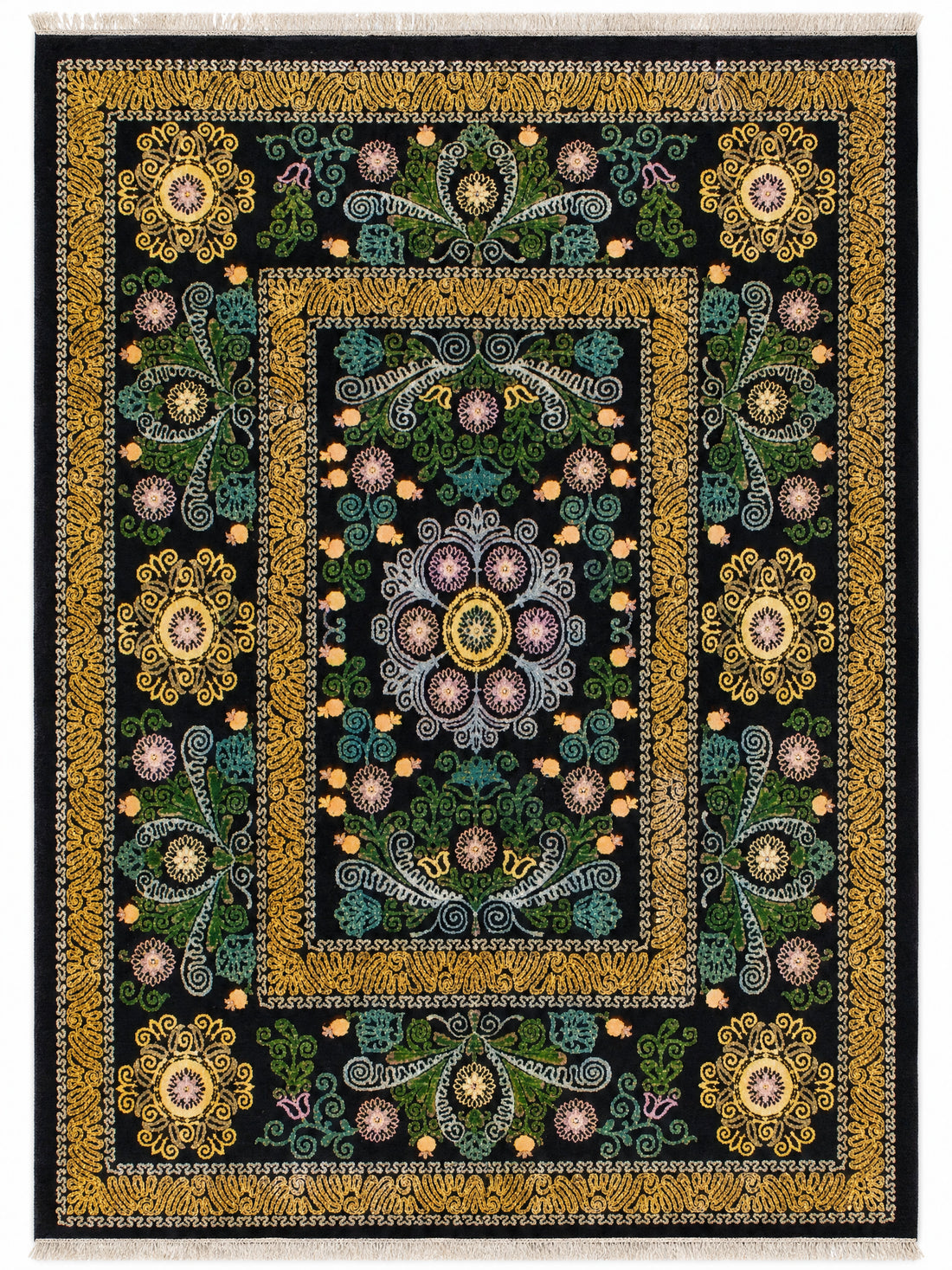
Suzani begins as embroidery — silk worked on cotton by hand, in Bukhara, Samarkand and Nurata, traditionally for a dowry rather than a market. Its language is large: rosettes opened like moons, pomegranates, vines that run the length of a cloth. The Loomish Suzani takes that vocabulary onto the loom, where a motif drawn for a needle has to be rebuilt knot by knot and holds a floor the way the original held a wall.
1 piece
Added to cart
The tradition
Suzani rugs
Questions
What is a Suzani?
A Suzani is a Central Asian textile tradition of silk embroidery on a cotton ground, worked principally in Uzbekistan and Tajikistan. The name comes from suzan, the Persian word for needle. A Suzani rug takes that design vocabulary — large rosettes, pomegranates and connecting vines — onto a hand-knotted pile.
Where does Suzani come from?
From Central Asia, principally Uzbekistan and Tajikistan. Bukhara, Samarkand, Shakhrisabz and Nurata are the historic centres, and each kept a recognisably different hand.
What do Suzani motifs mean?
The large rosettes are commonly read as moons or suns. Pomegranates stand for fertility, which fits the origin of the pieces as dowry textiles worked by a household before a marriage. The vines connect the medallions rather than crowding the ground between them.
What is the difference between an embroidered Suzani and a Suzani rug?
An embroidered Suzani is silk stitched onto cotton and was made to hang. A Suzani rug is hand-knotted in wool and takes the same design language onto a floor. Because a knotted pile is built on a grid, the drawing has to be rebuilt at the scale the knot can carry rather than copied stitch for stitch.
What size room suits a Suzani rug?
A large one. The composition is built from a few big forms and an open ground, so it resolves from a distance. In a small room the scale of a single rosette can take over.