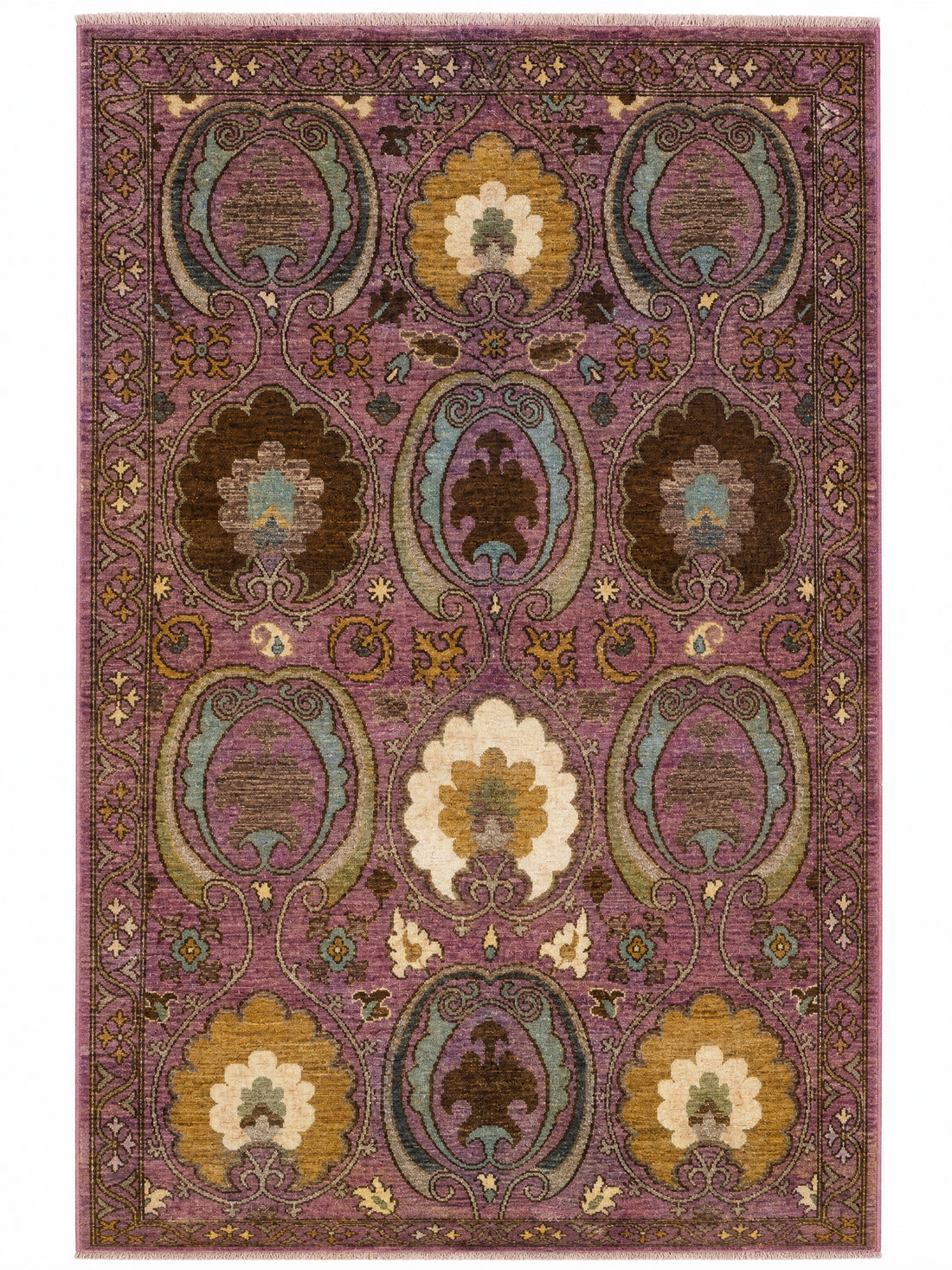
Khotan
Where worlds met, something rare was created. The Loomish Khotan collection celebrates a carpet tradition shaped along the Silk Road — a place where cultures, ideas, and artistic languages travelled together. Persian gardens, Chinese cloud forms, and Central Asian geometry blend into something entirely their own: expressive, unexpected, and impossible to place in just one world. Selected for their unusual colours, distinctive patterns, and unmistakable presence, these are pieces made for those drawn to something outside the ordinary.
3 pieces online now


End of the room
That is the selection online.
The house holds a great deal more than is shown here. What you do not see, ask for.


Added to cart
The tradition
Khotan rugs
Questions
What is a Khotan rug?
A Khotan is a hand-knotted rug from the design tradition of Khotan, an oasis city on the southern Silk Road in what is now Xinjiang. It combines Chinese, Persian and Central Asian motifs — pomegranate trees, open lattices, key-fret borders and cloudbands — in a characteristically open field.
How do you identify a Khotan rug?
Look for an open field rather than a dense one, a key-fret or meander border, and motifs drawn from more than one culture at once. The palette is the other tell: softer than Central Asian weaving, with coral-toned madder, ochre and a slate-leaning blue rather than deep indigo.
What is the difference between a Khotan and a Persian rug?
A Persian carpet generally builds density, curvilinear vines and a dominant central medallion. A Khotan leaves the field open, draws its forms more geometrically, and borrows Chinese motifs that never appear in Persian weaving.
Do Khotan rugs suit contemporary interiors?
Particularly well. The open field and muted palette give modern furniture the space it needs to be seen, where a dense carpet would crowd it.